
Sweet spot dawkowania CBD: jak dostroić dawkę zamiast zwiększać bez końca
Poznaj sweet spot dawkowania CBD: dlaczego krzywa dawka-odpowiedź ma kształt dzwonu, jak prowadzić titrację krok po kroku i kiedy większa dawka szkodzi.
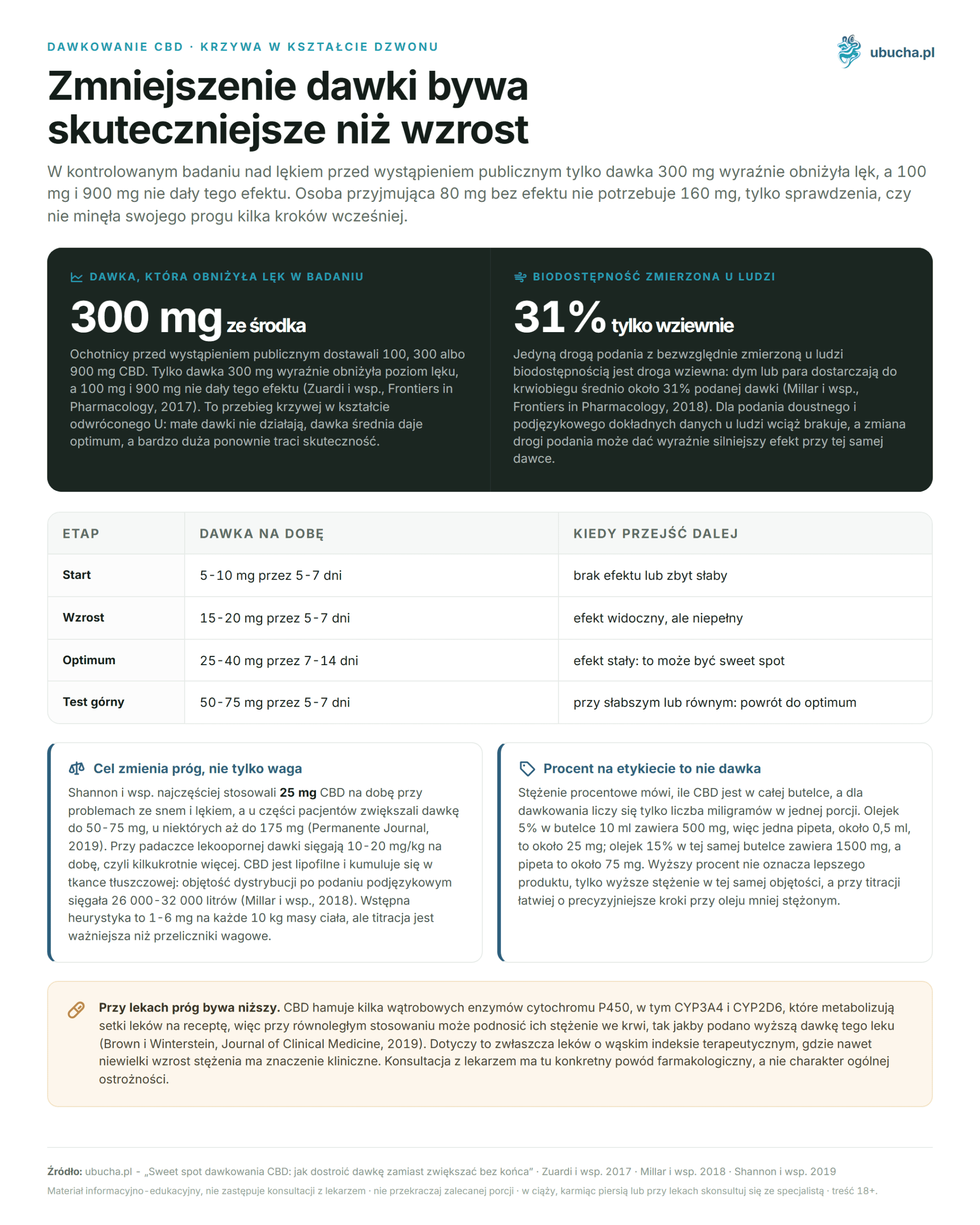
Wielu użytkowników CBD wpada w pułapkę „więcej znaczy lepiej”. Nie czują efektu przy małej dawce, więc podwajają porcję, czekają tydzień i podwajają ją znowu. Kończą na dawkach kilka razy wyższych niż faktycznie potrzeba, a efekt wcale się nie poprawia. Powód jest fizjologiczny, nie psychologiczny: CBD wykazuje nieliniową krzywą dawka-odpowiedź w kształcie dzwonu. W kontrolowanym badaniu nad lękiem sytuacyjnym 300 mg CBD łagodziło stres skuteczniej niż zarówno 100 mg, jak i 900 mg podane tej samej grupie (Zuardi et al., Frontiers in Pharmacology, 2017). Zbyt wysoka dawka może więc działać słabiej niż dawka umiarkowana. Ten artykuł tłumaczy ten mechanizm i podaje konkretny, czteroetapowy protokół dostrajania własnej dawki krok po kroku.
KLUCZOWE INFORMACJE
• CBD wykazuje krzywą dawka-odpowiedź w kształcie dzwonu: w badaniu nad lękiem 300 mg działało lepiej niż 100 mg i 900 mg (Zuardi et al., 2017).
• Punkt startowy rekomendowany przez badaczy to 5-25 mg na dobę, zwiększane o 5 mg co 3-7 dni.
• Sweet spot to najmniejsza dawka, przy której pojawia się zamierzony efekt: każdy wyznacza go indywidualnie.
• Droga podania (podjęzykowo, doustnie, wziewnie) zmienia biodostępność i czas działania.
• Zbyt szybkie zwiększanie dawki utrudnia znalezienie optymalnego progu.
Czym jest krzywa dawka-odpowiedź CBD i dlaczego ma kształt dzwonu?
CBD nie zachowuje się jak większość substancji aktywnych, przy których efekt rośnie proporcjonalnie do dawki. W kontrolowanym badaniu Zuardiego i współpracowników ochotnicy przed wystąpieniem publicznym dostawali 100, 300 albo 900 mg CBD. Tylko dawka 300 mg wyraźnie obniżyła poziom lęku, a 100 mg i 900 mg nie dały tego efektu (Zuardi et al., Frontiers in Pharmacology, 2017). To klasyczny przebieg krzywej w kształcie odwróconego U: małe dawki nie działają, dawka średnia daje optimum, a bardzo duża dawka ponownie traci skuteczność. Mechanizm tej nieliniowości nie jest w pełni wyjaśniony, ale wskazuje się na kilka czynników.
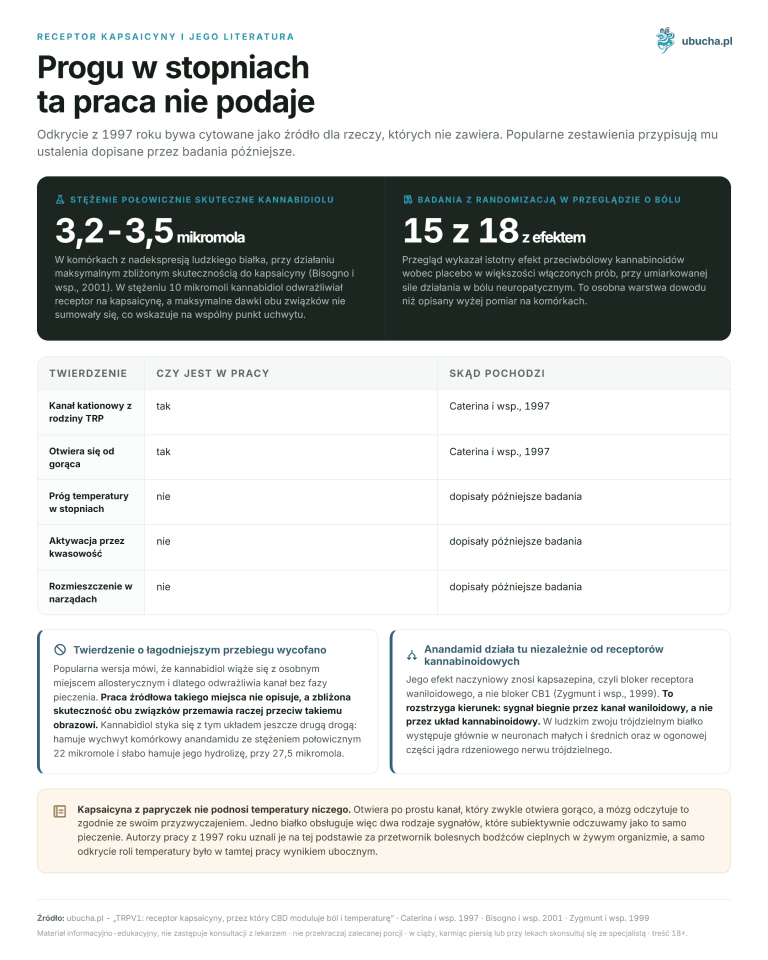
Po pierwsze, CBD oddziałuje na wiele receptorów jednocześnie: CB1, CB2, 5-HT1A (serotonina), TRPV1 (ból, temperatura) i GPR55. Każdy z tych receptorów ma inny próg nasycenia. Przy małych dawkach dominuje aktywacja receptorów 5-HT1A, a przy dużych aktywacja lub blokada innych szlaków może neutralizować pierwotny efekt. Po drugie, CBD podnosi poziom anandamidu, endogennego kannabinoidu wytwarzanego przez organizm, ale nie przez hamowanie rozkładającego go enzymu FAAH: ludzkiego FAAH kannabidiol nie hamuje, a wzrost tłumaczy konkurencja o wewnątrzkomórkowe białka transportujące z rodziny FABP, które dowożą anandamid do tego enzymu (Elmes, J Biol Chem, 2015). Wysycenie takiego nośnika bywa wymieniane jako wyjaśnienie górnego ramienia krzywej, ale samego przebiegu krzywej nikt w ten sposób nie zmierzył.
Konsekwencja praktyczna jest istotna. Osoba przyjmująca 80 mg CBD dziennie bez efektu nie potrzebuje 160 mg. Potrzebuje sprawdzić, czy nie przekroczyła już swojego optymalnego progu kilka kroków wcześniej. Właśnie dlatego protokół „mała dawka i obserwacja” działa lepiej niż eskalacja.
Jak krok po kroku wyznaczyć swój sweet spot CBD?
Titracja, czyli stopniowe dobieranie dawki, to metoda stosowana w farmakologii przy substancjach z indywidualnym oknem terapeutycznym. Shannon i współpracownicy opisali dużą serię przypadków klinicznych, w której pacjentom z lękiem i problemami ze snem najczęściej podawano 25 mg CBD wieczorem, po kolacji, a u części z nich dawkę stopniowo zwiększano nawet do 175 mg na dobę (Shannon et al., Permanente Journal, 2019). W praktyce konsumenci CBD dostępnego bez recepty zaczynają zwykle od jeszcze niższych dawek, by dokładniej zlokalizować własny próg. Metodyczny, gotowy do wydruku schemat takiej titracji opisuje nasz poradnik o titracji dawki CBD krok po kroku.
Poniższa tabela opisuje ustrukturyzowany protokół czteroetapowy. Każdy etap trwa minimum 5-7 dni. Kluczowe jest prowadzenie krótkiego dziennika: jak śpisz, poziom napięcia (skala 1-10), ewentualne objawy niepożądane.
| Etap | Dawka (mg CBD/dobę) | Czas trwania | Co obserwować | Kiedy przejść dalej |
|---|---|---|---|---|
| 1 - start | 5-10 mg | 5-7 dni | Jakość snu, poziom napięcia, trawienie | Brak efektu lub zbyt słaby |
| 2 - wzrost | 15-20 mg | 5-7 dni | Pierwsze wyraźne sygnały efektu | Efekt widoczny, ale niepełny |
| 3 - optimum | 25-40 mg | 7-14 dni | Spójny efekt, brak nadmiernej senności | Efekt stały: to może być Twój sweet spot |
| 4 - test górny | 50-75 mg | 5-7 dni | Porównanie z etapem 3 | Jeśli efekt słabszy lub równy, wróć do etapu 3 |
Jakie czynniki przesuwają sweet spot w górę lub w dół?
Sweet spot nie jest stały. Zmienia się w zależności od kilku zmiennych. Zrozumienie ich pozwala uniknąć błędu nadinterpretacji: zanim zwiększysz dawkę, sprawdź, czy nie zmieniła się któraś z tych zmiennych.
- Masa ciała i tkanka tłuszczowa. CBD jest substancją lipofilną i kumuluje się w tkance tłuszczowej. Przegląd farmakokinetyki CBD u ludzi wskazuje na bardzo dużą objętość dystrybucji: po podaniu podjęzykowym sięgała ona 26 000-32 000 litrów w badanych dawkach (Millar et al., Frontiers in Pharmacology, 2018). Wyższy procent tkanki tłuszczowej może oznaczać wolniejsze uwalnianie CBD i potrzebę wyższej dawki. Wstępne wytyczne sugerują 1-6 mg CBD na każde 10 kg masy ciała jako punkt orientacyjny.
- Cel stosowania. Badania kliniczne stosują bardzo różne dawki w zależności od wskazania. Shannon i współpracownicy najczęściej stosowali 25 mg CBD na dobę przy problemach ze snem i lękiem, a u części pacjentów zwiększali dawkę do 50-75 mg (Shannon et al., 2019). Przy epilepsji lekoopornej (Epidiolex) dawki sięgają nawet 10-20 mg/kg na dobę, czyli kilkukrotnie więcej. Sweet spot przy problemach ze snem będzie więc inny niż przy bólu przewlekłym, nawet u tej samej osoby.
- Tolerancja i czas stosowania. W przeciwieństwie do THC, CBD nie buduje silnej tolerancji farmakologicznej. Nie ma dowodów na to, że receptory CB1 podlegają pod jego wpływem down-regulacji tak jak pod wpływem THC. Mimo to część użytkowników zgłasza, że po miesiącach stosowania dawka traci skuteczność, co może wynikać z adaptacji innych szlaków sygnałowych albo ze zmiany stylu życia. Przerwa 2-4 tygodnie, tak zwany T-break, często przywraca wrażliwość na poprzednią dawkę. Sam protokół takiej przerwy opisuje nasz tekst o resecie tolerancji na CBD.
- Droga podania i biodostępność. Przegląd Millar i współpracowników pokazuje, że jedyną drogą podania z bezwzględnie zmierzoną u ludzi biodostępnością jest droga wziewna: dym lub para dostarczają do krwiobiegu średnio około 31% podanej dawki. Dla podania doustnego i podjęzykowego dokładnych danych u ludzi wciąż brakuje, ale efekt pierwszego przejścia przez wątrobę sprawia, że kapsułki i żelki tracą znaczną część substancji, zanim trafi ona do krwi. Zmiana drogi podania, na przykład z kapsułek na olej podjęzykowy, może więc dać wyraźnie silniejszy efekt przy tej samej dawce.
Kiedy więcej CBD zaczyna szkodzić zamiast pomagać?
Najczęstszy błąd to eskalacja dawki bez dziennika obserwacji. Użytkownik przyjmuje CBD tydzień, nie widzi wyraźnego efektu, podwaja dawkę, czeka kolejny tydzień i powtarza ten schemat, aż dochodzi do dawek 200-300 mg na dobę. Tymczasem w tym momencie może już być powyżej swojego sweet spotu od kilku tygodni.
Zauważamy ten wzorzec regularnie: klienci, którzy zaczynali od zbyt wysokiej dawki, na przykład ponad 100 mg „bo tak pisało na forum”, po powrocie do 25-30 mg zaczynali dostrzegać wyraźniejszy efekt. Paradoks dawkowania CBD jest realny, nie jest to marketingowy wymysł, lecz farmakologiczna cecha tej cząsteczki. Zjawisko to szerzej opisuje dr Dustin Sulak w swoim tekście o tym, dlaczego więcej CBD może działać gorzej.
Poza stratą pieniędzy, zbyt wysoka dawka może wiązać się z działaniami niepożądanymi: sennością, suchością w ustach czy zmianami apetytu. Iffland i Grotenhermen w przeglądzie badań klinicznych i danych toksykologicznych odnotowują te objawy jako najczęściej zgłaszane przy przewlekłym stosowaniu, choć bez jednoznacznie wyznaczonego progu dawki (Iffland & Grotenhermen, Cannabis and Cannabinoid Research, 2017). Chroniczne stosowanie nawet do 1500 mg na dobę okazało się w badaniach dobrze tolerowane. Brak efektu przy umiarkowanej dawce nie jest więc powodem do natychmiastowej eskalacji. Jest raczej sygnałem, żeby sprawdzić inne zmienne.
Czy stężenie oleju (%) ma znaczenie przy wyznaczaniu dawki?
Stężenie procentowe oleju CBD, na przykład 5%, 10% czy 15%, mówi, ile CBD jest w 100 ml lub 10 ml produktu. Dla samego dawkowania liczy się jednak tylko liczba miligramów w jednej porcji. Olejek 5% w butelce 10 ml zawiera 500 mg CBD: jedna pipeta, około 0,5 ml, to około 25 mg CBD. Olejek 15% w tej samej butelce 10 ml zawiera 1500 mg: jedna pipeta to około 75 mg CBD. Wyższy procent nie oznacza lepszego produktu. Oznacza po prostu wyższe stężenie w tej samej objętości.
Przy titracji łatwiej jest używać mniej stężonego oleju, bo pozwala on na precyzyjniejsze kroki dawkowania. Przejście na mocniejszy olejek warto rozważyć dopiero po wyznaczeniu sweet spotu: wtedy wiadomo, ile mg potrzebujesz, i można obliczyć, jaka pipeta mocniejszego oleju odpowiada tej dawce. Znajomość tego przelicznika ułatwia też porównywanie różnych produktów w sklepie, niezależnie od procentu podanego na etykiecie. Dokładne przeliczniki kropli na mg opisuje nasz przewodnik po wyborze dawki CBD w kroplach i mg.
Kiedy dawkowanie CBD trzeba skonsultować z lekarzem?
CBD hamuje kilka wątrobowych enzymów cytochromu P450, w tym CYP3A4 i CYP2D6, które metabolizują setki leków na receptę. Oznacza to, że przy równoległym stosowaniu leków CBD może podnosić ich stężenie we krwi, tak jakby podano wyższą dawkę tego leku. Mechanizm ten opisali szczegółowo Brown i Winterstein w przeglądzie interakcji lekowych CBD (Brown & Winterstein, Journal of Clinical Medicine, 2019). W praktyce oznacza to, że „sweet spot CBD” u osoby przyjmującej na przykład lek na nadciśnienie czy warfarynę może być znacznie niższy niż u osoby bez leków. CBD pośrednio wzmacnia działanie tych leków, więc ich standardowa dawka może zadziałać mocniej niż zwykle.
Jeśli przyjmujesz leki na receptę, konsultacja z lekarzem przed włączeniem CBD jest bezwzględnie potrzebna. Nie chodzi o ogólną ostrożność, lecz o konkretny powód farmakologiczny. Lekarz może sprawdzić, czy Twoje leki są metabolizowane przez CYP3A4 albo CYP2D6, i odpowiednio dostosować monitorowanie oraz dawkowanie CBD. Dotyczy to zwłaszcza leków o wąskim indeksie terapeutycznym, gdzie nawet niewielki wzrost stężenia we krwi ma znaczenie kliniczne.
Najczęściej zadawane pytania
Co to jest sweet spot dawkowania CBD?
Sweet spot to indywidualna dawka CBD, przy której osiągasz zamierzony efekt przy minimalnym ryzyku działań niepożądanych. Ze względu na nieliniową, dzwonową krzywą dawka-odpowiedź CBD optymalna dawka nie jest oczywista i wymaga ustrukturyzowanej titracji oraz obserwacji przez co najmniej 2-3 tygodnie (Zuardi et al., Frontiers in Pharmacology, 2017).
Ile mg CBD to dobry punkt startowy?
Dla zdrowej osoby dorosłej rozsądny start to 5-10 mg raz dziennie, zwiększane o 5 mg co 5-7 dni. Duża seria przypadków klinicznych Shannon i współpracowników pokazała, że u dorosłych z bezsennością i lękiem najczęściej stosowaną dawką startową było 25 mg CBD wieczorem, po kolacji (Shannon et al., Permanente Journal, 2019). Im wolniejsza titracja, tym dokładniejsze wyznaczenie własnego progu.
Kiedy CBD przestaje działać przy większej dawce?
Zjawisko to wynika z dzwonowej krzywej dawka-odpowiedź CBD. Przy zbyt wysokich dawkach CBD może aktywować dodatkowe szlaki sygnałowe, które neutralizują pierwotny efekt, albo po prostu nasycić docelowe receptory. Zuardi i współpracownicy potwierdzili ten wzorzec eksperymentalnie: dawka 300 mg CBD obniżała lęk przed wystąpieniem publicznym, a dawki 100 mg i 900 mg już nie (Zuardi et al., Frontiers in Pharmacology, 2017). Zmniejszenie dawki bywa więc skuteczniejsze niż jej dalsze zwiększanie.
Jak długo czekać na efekty CBD przy nowej dawce?
Przy oleju podjęzykowym efekt pojawia się w ciągu 15-45 minut, ale stabilizacja stężenia we krwi wymaga 5-7 dni regularnego stosowania. Przy kapsułkach i żelkach pełna kumulacja zajmuje nawet 2 tygodnie. Zmiana dawki częściej niż co 5 dni utrudnia ocenę i prowadzi do błędnych wniosków.
Czy waga ciała wpływa na dawkę CBD?
Waga jest jednym z czynników, ale nie jedynym. CBD kumuluje się w tkance tłuszczowej, więc większa masa ciała może wymagać wyższej dawki do osiągnięcia tego samego stężenia we krwi, co potwierdza duża objętość dystrybucji CBD opisana w przeglądzie farmakokinetycznym Millar i współpracowników (Millar et al., Frontiers in Pharmacology, 2018). Wstępna heurystyka to 1-6 mg na każde 10 kg masy ciała, ale cel stosowania i indywidualny metabolizm przesuwają ten zakres. Titracja jest ważniejsza niż przeliczniki wagowe.
Jeśli szukasz oleju CBD do rozpoczęcia własnej titracji, przegląd dostępnych stężeń znajdziesz w kategorii olejków CBD w sklepie u Bucha.
Artykuł ma charakter informacyjno-edukacyjny i nie stanowi porady medycznej. Przed rozpoczęciem stosowania konopi lub CBD w celach terapeutycznych skonsultuj się z lekarzem, zwłaszcza jeśli przyjmujesz inne leki, jesteś w ciąży lub karmisz piersią.
Autor: Michał Waluk · Opublikowano: 2026-07-31 · Aktualizacja: 2026-08-17